

By Gail Boushey Published: 5/4/2026 Updated: 7/1/2026
This fall you are walking into a school carrying deep knowledge, proven skill, and a genuine desire to make a difference. The curriculum is in hand. The training is done. The teachers are waiting.
And the most important coaching you will do this year may have nothing to do with phonics.
Underneath every scripted lesson, every pacing guide, every fidelity checklist, there are assumptions about the classroom where the lesson will be taught.
The assumptions are that:
When a classroom has that kind of predictability, when students own their work and move through the day with focus and direction, a strong literacy curriculum does exactly what it was designed to do.
The teacher delivers a clear, focused lesson. Students practice. The teacher moves through the room, confers with one reader, pulls a small group who needs the same thing, responds to student needs in real time.
When those conditions are still being built, the teacher spends their energy differently. They stop the lesson to redirect. They answer the same procedural question several times. They stay close to the whole group because the moment they step away, hands go up. The curriculum is present, but the foundations of that classroom are still taking shape.
This is skilled, specific work the teacher must do first. Building a classroom with that kind of ownership and focus takes time and intentional teaching. Many teachers are doing pieces of it already, from years of instinct and experience.
Over two decades in classrooms, from Daily 5 to CAFE to Prepared Classroom, we kept seeing the same nine practices in strong teaching.
When we mapped them to John Hattie’s research of over 2,100 meta-analyses, the research confirmed the success we've been seeing in classrooms.
These are the highest-leverage moves teachers can learn, use, and return to at any stage of a career.
The Teaching Practice puts all nine of those practices in your hands before you walk into your first classroom. It provides a clear picture of what each one looks like and how to build it deliberately with every teacher in your building.
There is a reason I feel strongly about coaches having this before they start. I lived the alternative.
In 2010 I stepped out of the classroom and into my first coaching role at Meridian Elementary in Washington State. Instructional coaching was so new as a field that the roadmap was still being written. I went in full of belief and readiness.
I remember walking into classrooms that first week of school and feeling something different from any other building I'd been at. The literacy programs were not yet open. What I was seeing instead was teachers welcoming students who had just arrived and were just getting to know each other. They were building community. Teaching routines for how we work together, how we support each other, how we move through our day. Practicing what it looks and sounds like to work on your own.
At the time I wasn't sure what I was seeing. Now it's blatantly obvious. About two weeks in, I sat down and reflected on how everything was going. I had gone in believing I was coaching on literacy. And I was. But I was also realizing that we had hardly even touched the curriculum, yet it wasn't a detour from the learning. We were establishing the conditions that made true learning possible. We were setting the stage for the rest of the year.
Coaching in literacy grows over time. The beginning of the year is where the roots are set. Welcoming students. Building belonging. Teaching routines that help them learn and practice the behavior expectations.
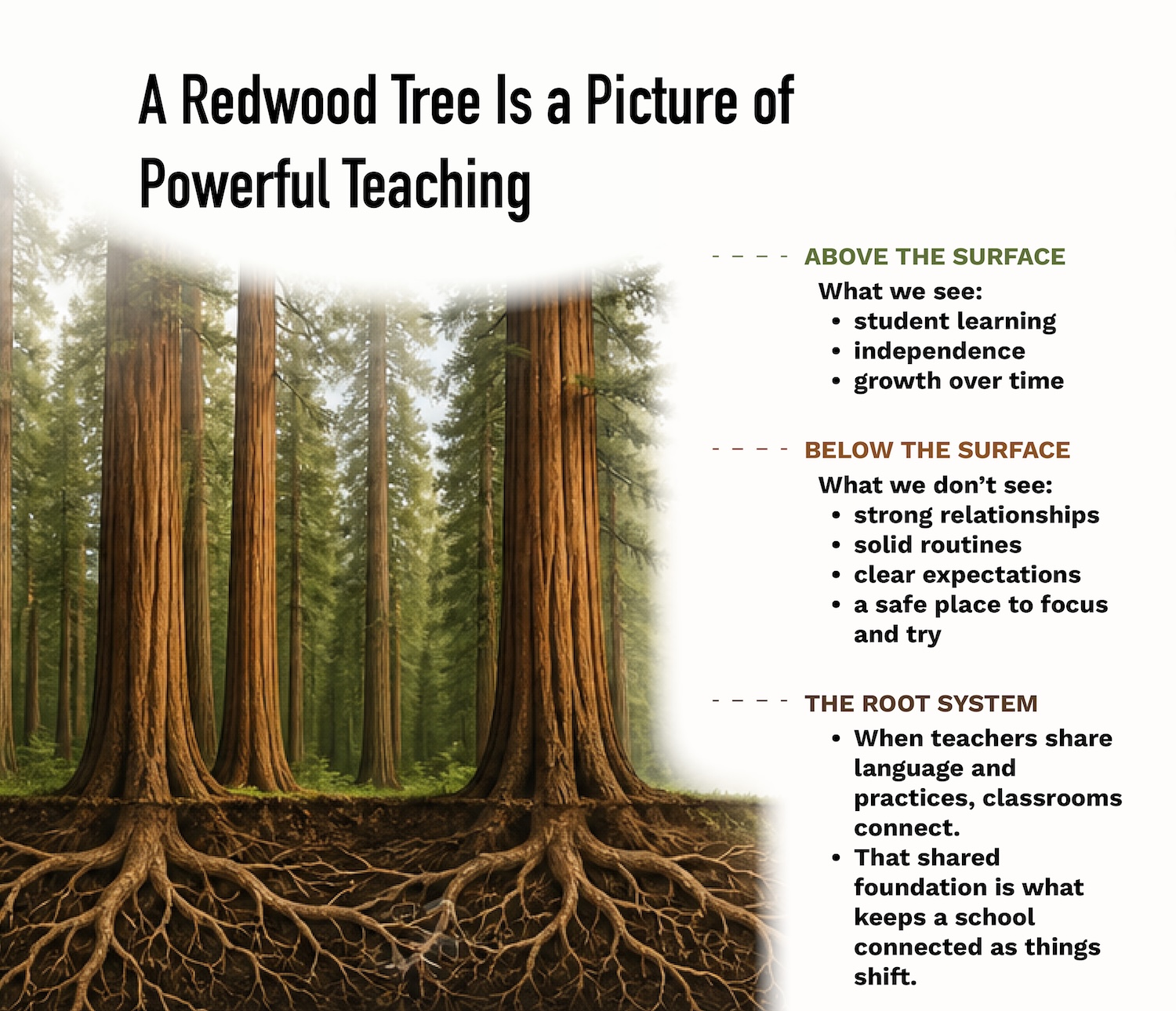
A lot of this lives below the surface. As those roots strengthen, learning begins to rise. Students read, write, and think with more independence. Growth is reliable and strong.
Like a redwood, the height depends on what’s happening underground. When the roots are deep and connected, the tree can keep growing.
One classroom with this foundation is powerful.
A whole building is something else.
When teachers share this way of working, they form a kind of grove. Students move from room to room with the same sense of clarity and purpose. Even as things around it shift, or a new program is adopted.
That’s the part I wish I had known earlier. And how to help every teacher begin in a way that supports learning growth.
Redwood trees grow in a unique way. Their roots spread wide and connect with the roots of nearby trees. Over time, they intertwine and support each other. That shared root system is what helps them stand tall and remain grounded through wind and storms. Together, they form a grove and is the only way for a tree to reach the 350ft+ record-holding height.
I want it to be different for you. You are arriving with a mandate, a curriculum, and a genuine desire to make a difference. What most coaches do not yet have, and what this is about, is a complete framework for teaching itself. Not just literacy instruction, but the relationships, the environment, the routines, the ownership that make any instruction possible.
The Teaching Practice was built to answer that. You'll build nine practices that together answer the question every principal, every teacher, and every coach is eventually asking: What does effective teaching look like here?
And the answer to that question reaches well beyond how to teach a phonics lesson.
It lives in whether:
That is the classroom where literacy instruction can soar. And building it is exactly what coaching can do.
The curriculum assumes the classroom is already set up for learning. The coach's job, especially in those first critical weeks, is to make sure it is. Coaching starts here because they create the conditions everything else requires:
These are the first of the nine practices and are the foundation. When they are in place, the deep literacy work you're there to support can take shape. You simply cannot if the classroom is still finding its footing.
Relationship is the first practice because it is what makes teaching possible. When students feel genuinely known by their teacher, they take the risks that learning requires. They attempt the unfamiliar word. They ask when they are confused. Every phonics lesson, every fluency routine, every comprehension strategy a teacher introduces goes deeper in a classroom built on that kind of trust.
Environment is the second practice because the physical space either supports learning or competes with it. Materials are accessible. Spaces are clear. Students know where to go and what to do. The teacher can move freely and give full attention where it’s needed.
Daily Routines are the third practice because they turn procedures into automatic behaviors. They create consistency. Students know what to do when they finish, when they are stuck, when they need something, when the teacher is working with someone else. The cognitive energy that would have gone to figuring out logistics goes to reading instead.
Independent Learning is the fourth practice because it is what the teacher's responsiveness depends on. A teacher whose students are focused, directed, and invested in their own learning can pull a small group, confer with individual readers, and adjust instruction in real time based on what they are actually seeing.
Start here with every teacher in your building. Help them see these four practices clearly, build them deliberately, and watch what opens up for the literacy coaching that follows. Inside the Teaching Practice, any teacher can be trained on these first four practices in under four hours.
Here is what coaching without a shared framework often looks like:
That work takes years. And the teachers in a school can only grow as far as what one coach has had time to build.
John Hattie put it plainly: we want great teachers by design, rather than by chance. A school where teacher growth depends on what one coach has managed to create on their own is a school growing by chance.
The Teaching Practice on TeachDaily.com was built to change that. Every one of the nine practices is taught through video, articles, milestones, and success criteria. The expertise lives in the platform. The coach walks alongside a teacher who is building something without having to build the tools from scratch.
That shift changes how teachers receive coaching. When the nine practices are termed inside a shared resource, the coach is a colleague on the same journey. The teacher is the expert on their students. Together they have a common map and a common language. Every conversation goes somewhere specific and every next step is clear.
And when an entire school is working from that map together, something larger becomes possible:
That is a school growing by design.
The most powerful thing you can do right now is get clear on the nine practices before you walk into your next classroom.
Know what each practice looks like when it is fully in place. Know where to begin with a teacher who is ready to build and where to begin with one who is still setting roots.
Those first weeks are where the roots take hold. Relationships, environment, routines, and student independence grow beneath the surface.
When those roots are strong, everything above them can grow. The deeper work of literacy coaching rises from there.
Your teachers are going to open their doors to you. That is an act of trust. It deserves the best you have to give them.
The Teaching Practice makes sure what you bring is comprehensive, research-grounded, and ready to use from day one.
You now have what every coach needs before the first lesson. A clear picture of what effective teaching looks like here, and a path to build it with every teacher in your building.
Quick lessons you can teach in 10 mins/day so students take responsibility for their learning and rely on you less.
Get the LessonsTeaching is complex. And the challenges teachers are navigating right now are real.
Strong programs, new mandates, and growing expectations have changed what classrooms look like. Yet the foundations of effective teaching remain the same.
Students need to practice independently.
Teachers need time to respond to learners.
Learning needs structure to carry forward.
These are skills that can be built.
At Teach Daily, we focus on the structure of teaching. How lessons, independent practice, and responsive conferring work together across a day so learning lasts.
Choose your next move:
If you want to see the structure clearly, watch this training:
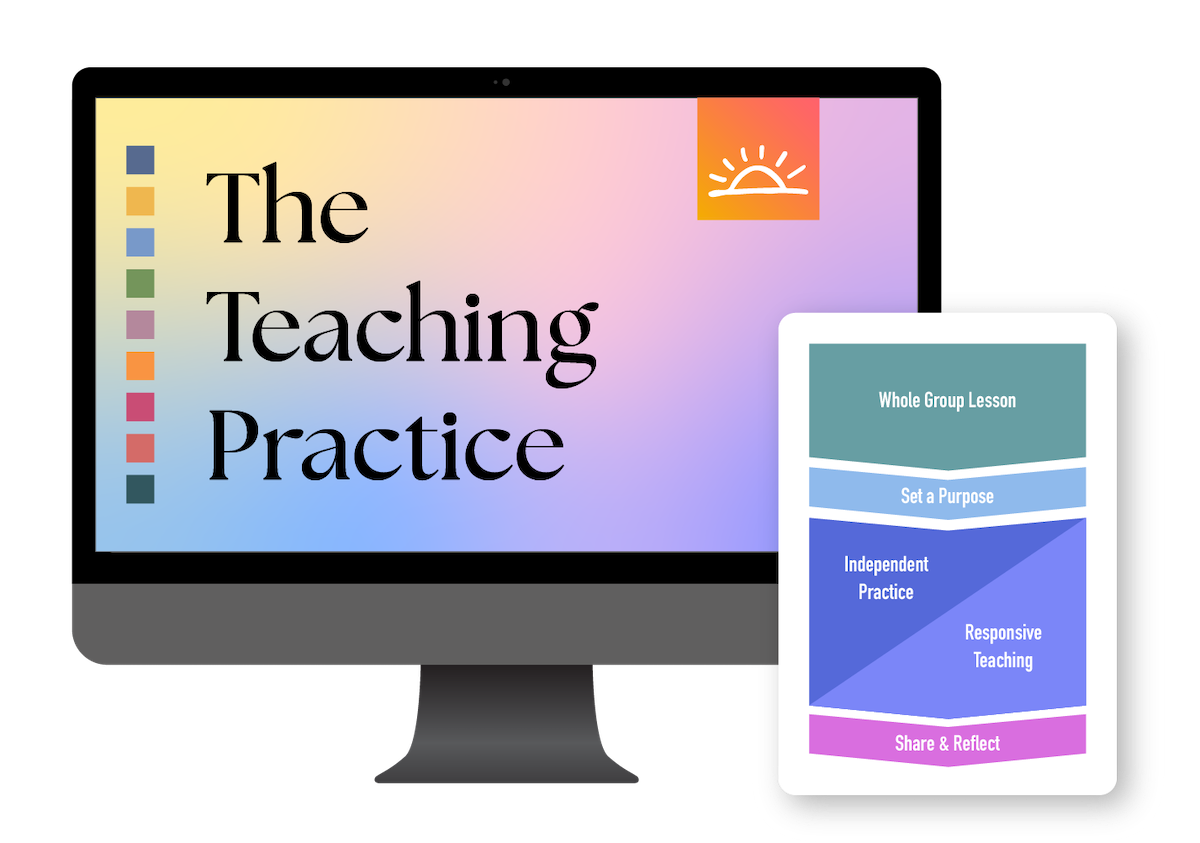
If you’re ready to strengthen these skills:

© 2026 Teach Daily
This site is protected by reCAPTCHA and the Google Privacy Policy and Terms of Service apply.