When the teacher is meeting with a small group, what is the rest of the class doing?
That question started everything. It’s the question Gail Boushey and Joan Moser were asking in their own classrooms more than 20 years ago. Their students had varying abilities and needed different instruction. But to provide that individualized, responsive teaching, there had to be purposeful work happening for the rest of the class at the same time.
Their answer was Daily 5.
Daily 5 gave more than one million teachers a structure for the literacy block : five authentic tasks students could sustain independently while the teacher worked with small groups and individuals. It worked. Teachers saw transformation. Students became more engaged, more focused, more capable of directing their own learning.
But something important was hiding inside that work. Something that took years of watching teachers and students to fully see.
The Question Evolved
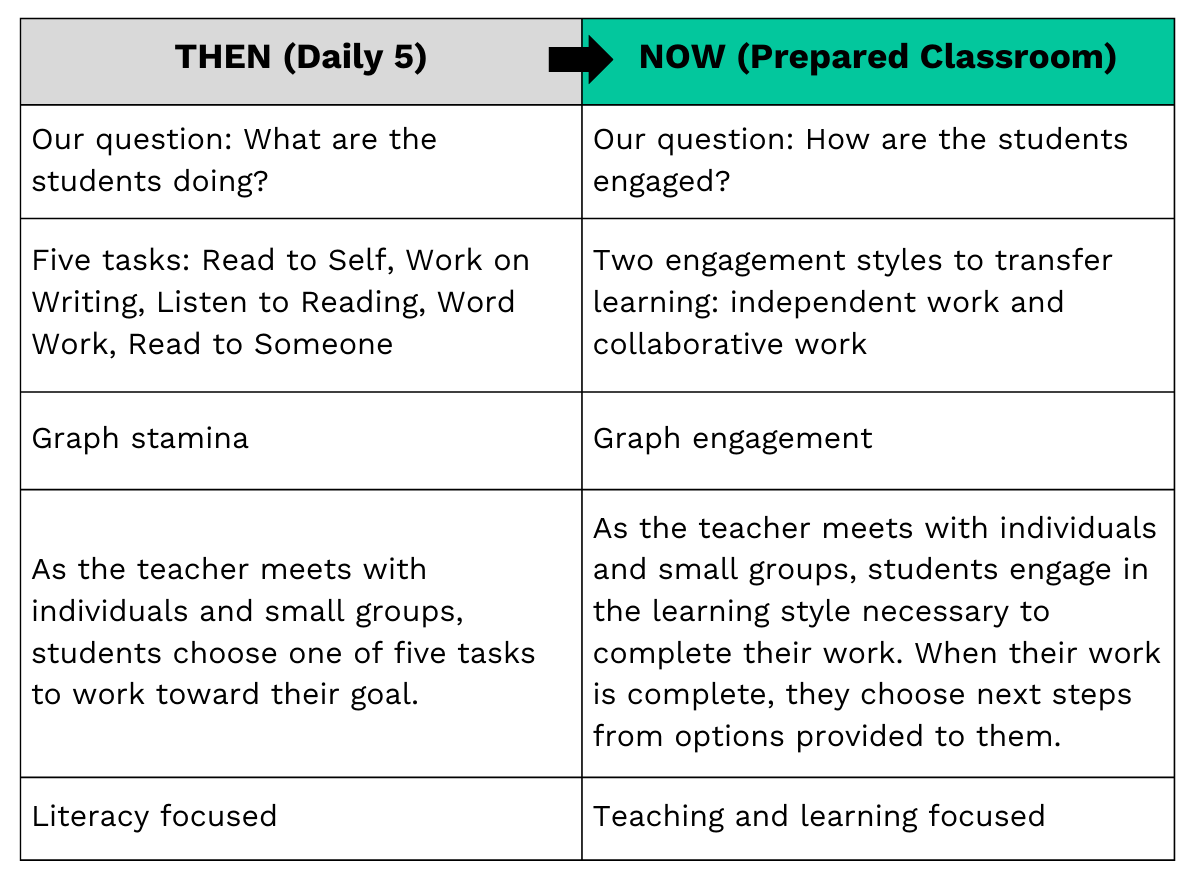
In the beginning, the question was: “What are students doing while I’m teaching?”
That’s a management question. It’s a valid one. And Daily 5 answered it well with five specific literacy tasks: Read to Self, Work on Writing, Read to Someone, Listen to Reading, and Word Work.
But as the years passed, a deeper question began to emerge: “How are students engaged in learning : and how do I build the capacity for that to happen consistently, in any subject, across the entire day?”
That shift, from what to how, is the heart of where this work has gone.
Because here’s what became clear over time: Daily 5 wasn’t really about five tasks. It was about teaching students to be self-managers. It was about building the kind of independence that makes responsive, individualized teaching possible. The tasks were the vehicle. The practices underneath were the destination.
What Was Hiding Inside Daily 5
When the publisher first proposed the Daily 5 book, they suggested it was more about management than literacy. At the time, we kept it in the literacy lane because that’s where it lived.
They weren’t wrong. The foundational practices inside Daily 5 : building relationships, creating predictable routines, developing student independence, teaching students to sustain their own learning : were never really literacy-specific. They were teaching practices. Universal ones. The kind that make any subject work, at any grade level, with any curriculum.
The same was true of CAFE. The conferring structures, the goal-setting, the progress monitoring, the brief and focused lessons : those weren’t reading strategies. They were teacher practices. The practices that make responsive, individualized instruction actually possible.
Prepared Classroom is what happened when we deconstructed both systems and named what was inside them: eight high-leverage teaching practices that make all teaching work, not just literacy.
From Five Tasks to Two Engagement Styles
In Prepared Classroom, the five tasks of Daily 5 have given way to two engagement styles: Independent Learning and Collaborative Learning.
This isn’t a simplification. It’s a clarification. The shift keeps the focus where it belongs : on how students are working, not just what they’re doing.
Independent Learning is the time when students sustain their own work : without constant teacher direction, with genuine focus, toward a clear purpose. Collaborative Learning is the time when students support each other’s thinking through structured, productive interaction.
Both engagement styles are explicitly taught using the same Ten Steps to Teaching and Learning Independence that Daily 5 teachers will recognize. Both can be used across any content area, any grade level, any time of day. And both create the conditions that make the most important teaching possible: the responsive, targeted instruction that happens when students can work without you.
The Question That Never Changes
The original question "what is the rest of the class doing while I’m teaching?" still matters. It’s still the right question to ask.
But we’ve learned to ask a deeper one alongside it: How do I build a classroom where students can sustain purposeful, independent work : so that I can do the teaching that makes the biggest difference?
That’s the question Prepared Classroom is built to answer. Not just for the literacy block. For every subject, every hour of the day, every teacher at every stage of their practice.
The practices that made Daily 5 and CAFE work are still here. They’ve just been named, expanded, and made available to every teacher : regardless of what curriculum they’re using or what mandate is sitting on their desk.