The lesson is only the beginning.
Learn how it becomes something students can do on their own.
↓ Watch the workshop ↓
Captions are available and watch speed can be adjusted.
Captions are available and watch speed can be adjusted.

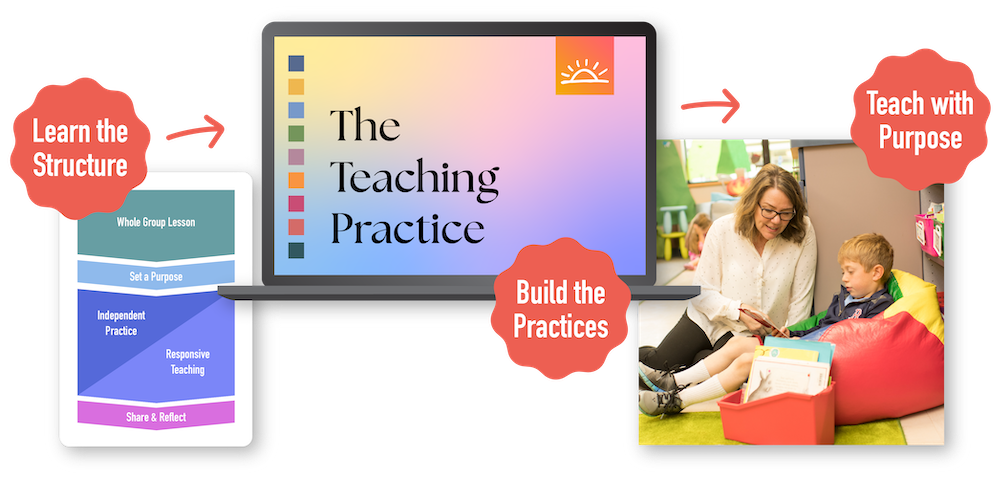
Inside The Teaching Practice is everything you need to implement The Teaching Structure in your classroom.
You will know exactly how to:
What you get with your membership:
Soon it will be $199/year

BUT still, students need a way to take what was taught and use it during their own work.
Curriculums don't teach that.
When you have a structure that makes your lesson transfer, learning happens.
This happens deliberately, over time, at your own pace.
You already know where it fits. Because this structure works with any curriculum. It does not replace what you use (or will use). It simply makes your program work better. You're choosing to invest in you as a teacher.
An effective structure to hold our teaching leads to student learning. That's it.
You saw it in a way most teachers have never seen before.
It's the full picture of how teaching and learning fit together across a day.
You already understand the importance of this work. This gives you a place to keep building it.
Lock in this price today, keep it forever.
Soon it will be $199/year
In the first 24 hours
You’ll understand how the parts of your teaching fit together—lesson, practice, conferring, and student learning. And the keys to increasing motivation, engagement, and learning transfer.
Within the first week
You can begin strengthening routines and transitions, creating more time and focus in your day.
Within the first month
You can have a clear system in place for students to work independently and stay engaged while you meet with individuals or small groups.
Time Commitment
The full set of course videos is about 8 hours total. Most teachers watch in short segments and apply one idea during the school day. There is no set pace. You move through the work as it fits your schedule.
Why You Have Ongoing Access
This work improves your classroom quickly and it deepens over time. As you continue teaching, you’ll return to lessons to refresh your thinking, refine your practice, and apply the structure in new ways.
Many teachers move through the full path within a few months. Deep implementation often unfolds over one to three years.
This is something to return to as your teaching grows.
Soon it will be $199/year
A few questions can help you see where you are.
When your lesson ends and students go off to work, can all of them sustain their own learning for thirty to forty minutes without needing you? When you move through the room to confer, do you know what to look for, what to say, and when to move on? When the block ends, do your students leave with the learning consolidated, or does it feel like it evaporated by the next day?
If any of those questions surfaced something, you have found your starting point.
The Teaching Structure is built to make those moments visible and addressable. Each component of the structure has a set of practices underneath it. When something is not landing in your block, the structure shows you exactly which component to look at and which practice to build next.
Great resources feel like the answer. And it makes complete sense that teachers build libraries of them. When you are looking for something to put in front of students that will engage them and move them forward, a well-designed activity feels like exactly what you need.
Here is what changes when you have the foundations of teaching underneath you.
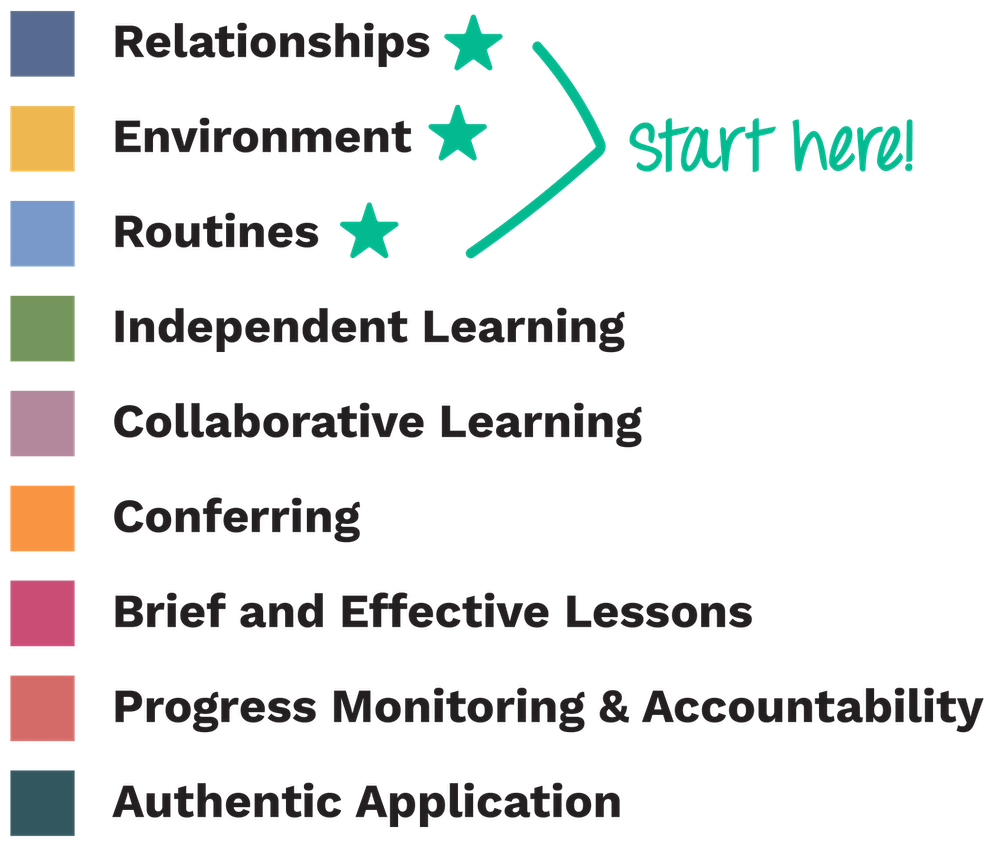
The nine foundational practices cover how to structure and deliver a whole group lesson, how to build student independence, how to confer and teach responsively, how to assess in real time and respond to what students actually show you. These are what make teaching work. Not the materials. The knowledge.
When you have that knowledge, something shifts. You stop needing to find the right resource and start being able to teach. If you know the skill, the strategy, or the learning target your students need next, you have everything required to build a lesson, deliver it, and respond to what happens in the room. The curriculum standard becomes the starting point. Your teaching knowledge is what takes it from there.
Teachers who build these foundations often describe the same realization: the folders of downloaded activities become largely unnecessary. Because they no longer need someone else to do the teaching for them. They can do it themselves, for any student, any content, any day.
Over the course of a career, that shift saves thousands of dollars in purchased resources. More importantly, it builds something no download can provide: a teacher who can reach any learner in front of them because they understand how learning works and how to respond when it is not happening yet.
The resources were never the foundation. The teaching knowledge is.
This is for every teacher. Some of the teachers who have found this work most transformative have been teaching for twenty and thirty years. Experience is an asset here. The more time you have spent in a classroom the faster this lands, because you have seen these practices in action even when you did not have language for them yet.
Maryanne Wolf said it directly: regardless of prior training, every teacher has something to give from their expertise, and every teacher has something to expand.
John Hattie's research on teacher credibility and expertise shows that teachers who actively build their knowledge and craft at any stage of their career have among the highest impact on student outcomes of any factor he has studied, with an effect size of 0.90?. The craft of teaching is never finished. There is always a next practice to build. A next level of depth to reach.
Linda Darling-Hammond's research at Stanford confirms that teacher knowledge and skill make more difference for student learning than any other single factor. Veteran teachers bring something newer teachers do not have: years of classroom experience to connect this work to. That makes the learning faster and the impact deeper.
Yes. The Teaching Structure is built on how students learn, not on what grade they are in or what subject is being taught. The five components work the same way in a kindergarten literacy block as they do in a high school science class or a middle school math period.
Brian Rosenshine's Principles of Instruction were drawn from research across grade levels and content areas. The principles that make a Whole Group Lesson effective in second-grade reading are the same principles that make it effective in ninth-grade writing or fifth-grade math. You learn the structure once and you carry it across every block you teach.
Teachers at every grade level, from early childhood through high school, have described the same experience: once they could see the structure clearly, they could see exactly where their block was working and where it had room to grow. The structure scales. The practices deepen with experience. The foundation holds at every level.
If your students are doing fine, something is working. The question the Teaching Structure invites is a different one: what becomes possible when your students do more than fine?
John Hattie's research identifies the practices with the highest impact on student outcomes. Feedback at 0.73. Formative assessment at 0.68. Teacher-student relationships at 0.72. These are not the practices of a struggling teacher. They are the practices of an exceptional one. And they are learnable at any stage of a career.
Many experienced teachers describe finding this work not as a correction but as a clarification. They were already doing pieces of it. What the Teaching Structure gave them was language for what they were doing, a way to do it more consistently, and a path to the practices they had not yet reached.
The craft of teaching is never finished. Every teacher, no matter how long they have been in the classroom, has a next level. This work is how you find it.
That is real. Teaching is relentless, and adding anything to a full plate takes intention.
The Teaching Practice is designed for exactly that reality. You do not take a course on top of your teaching. You build one practice at a time, in your classroom, with your students. The learning happens inside the work you are already doing, not alongside it. The courses are structured with specific action items to bring the work into your classroom in a manageable way.
Anders Ericsson's research on skill development shows that meaningful growth does not require massive time investment. It requires deliberate, focused practice on the right thing. A few intentional minutes each day, applied to one specific practice, produces more growth than sporadic large investments scattered across many areas.
Teachers who have built this work into their year consistently describe the same experience: the time investment pays back. When students can sustain independent work, when conferring becomes efficient, when the close actually consolidates learning, the block starts working harder than it ever did before. You get time back.
Yes. The Teaching practice is completely self-paced. There are no deadlines, no cohorts you fall behind, no pressure to move before you are ready.
Your progress saves exactly where you are. You can step away for a week, or a month, and return to exactly where you left off. The path holds.
The structure is built around one foundation at a time. You do not need to see the whole path before you take the first step. Each practice builds on the one before it, and each one produces results in your classroom before you move to the next.
You are never behind. You are exactly where you are. And the next step is always clear.
Yes. Completely. Your scripted program gives you the Whole Group Lesson. The explicit instruction, the modeling, the sequenced content delivered to your whole class. That is exactly what it was built to do. And it belongs right there, at the top of the block, in Component One of the Teaching Structure.
The Teaching Structure shows you everything that surrounds it. The practice time that follows the lesson. The responsive teaching that happens while students work. The close that moves learning into memory. The program provides the lesson. The Teaching Structure organizes the whole block.
There is something else worth knowing. Whether or not you use a scripted program, the Whole Group Lesson is one of the nine foundations of teaching. We teach it as a skill. How to identify one clear learning target. How to model your thinking so students can see inside the process. How to recognize the moment when instruction needs to stop and practice needs to begin. Teachers with scripted programs and teachers without them both build this foundation inside The Teaching Practice.
John Hattie's research shows that explicit instruction has an effect size of 0.57, well above the threshold for meaningful impact. Your program delivers that instruction. The Teaching Structure makes sure the rest of the block does its job. They are designed to work together.
Maryanne Wolf, neuroscientist and author of Proust and the Squid, states clearly that there are no interventions that fit every child. Teachers who understand the structure of the block are prepared to use whatever program they have to its fullest potential. The program provides the content. The teacher provides the responsiveness.
A scripted program tells you what to say and in what order. Knowing how to teach means something different. It means knowing what to do when the lesson ends and students are in front of you with twenty-five different levels of understanding. It means knowing how to build the kind of independence that lets you move through the room while students are working. It means knowing how to read what students show you and respond in the moment, not after the unit test.
The Teaching Structure is not about the lesson. It is about everything that surrounds the lesson. What happens in the thirty to forty minutes after the script is done. How students practice. How you move. What you are looking for. How you bring the learning to close so it moves into memory.
John Hattie's research shows that feedback has an effect size of 0.73 and formative assessment 0.68. Two of the highest-impact practices in all of education. Neither of them lives inside a scripted lesson. Both of them live in what happens after it.
Many experienced teachers who come to this work describe the same moment: they could see, for the first time, that their program was delivering the content and their students were receiving it, but the transfer was not happening. The Teaching Structure showed them exactly where in the block that gap was living. And exactly how to close it.
This is one of the most important questions a teacher using a scripted program can ask.
When a scripted whole group lesson fills the entire block there is no time left for students to practice what was just taught. No conferring. No small groups. The lesson becomes the whole block and students never have time to make the learning their own.
John Sweller's cognitive load research shows that working memory is finite. Students can only hold a limited amount of new information at once. A longer lesson does not produce more learning. It produces more forgetting.
Stanislas Dehaene's neuroscience research confirms that learning consolidates through application and retrieval, not through continued instruction. The block has to hold both instruction and practice.
A 2024 Stanford meta-analysis of literacy interventions, led by Rebecca Silverman, found that programs showing the strongest positive effects included opportunities for practice and feedback alongside instruction. That is what the rest of the block is for.
The Teaching Structure helps you look at your block honestly and find where practice can live. When we shorten the whole group lesson to 10–15 minutes and teach students how to engage with their work independently, time opens up for students to practice what we taught in the whole group lesson for 15–30 minutes at a time. We can show you how to get there inside The Teaching Practice.
Completely. Science of Reading tells you what to teach: the content, the phonics, the structured literacy practices that the research supports. The Teaching Structure organizes how you teach it and what happens in the entire block around that instruction.
Rebecca Silverman, a Stanford researcher studying Science of Reading implementation, named the gap directly in 2026: teachers need infrastructure for continued professional learning so they can dive deeper, get feedback, and grow. That infrastructure is what The Teaching Practice provides.
Nell Duke and Kelly Cartwright's Active View of Reading research shows that student reading success depends not just on decoding and language comprehension but on self-regulation, executive functioning, and motivation. Those are capacities no curriculum builds. They are built through the teaching practices inside The Teaching Structure.
Maryanne Wolf adds an important note from neuroscience: we need to address both phonics and the broader comprehension and language capacities that develop through extended reading practice. The Teaching Structure is built to hold all of it.
Hollis Scarborough's Reading Rope research shows that skilled reading is made up of many strands: word recognition, language comprehension, background knowledge, vocabulary, and more. No single program addresses all of them. The Teaching Structure creates the conditions for every strand to be taught, practiced, and developed.
Science of Reading and the Teaching Structure are the complete picture together.
Daily 5 taught student practices: how to build the independence students need to sustain their own work. CAFE taught teacher practices: how to confer responsively and teach based on what students actually show you.
Prepared Classroom extracted the universal foundations underneath both and organized them into a complete teaching structure that works across every subject and every grade level.
Pearson and Gallagher's gradual release research, the same research that grounded Daily 5, remains the foundation here. The Teaching Structure makes it visible across every block you teach, every day, in every subject. If you built Daily 5 classrooms you already know what it felt like when your students could sustain their work and you were free to move through the room. The Teaching Structure gives you the language for why that worked and The Teaching Practice members gives you a deliberate path to build every practice that surrounds it.
Yes. The Teaching Structure is built around responsive teaching: the practice of adjusting instruction in real time based on what each student is actually showing you. That is precisely what students with IEPs, multilingual learners, and students working below, on, and above grade level need most.
The diagonal line shows the relationship between independent practice time and direct teacher support. A student who needs more support gets more time with the teacher. A student building independence gets more sustained practice time. Every student is on the diagonal. The teacher moves to where they are.
Nell Duke and Kelly Cartwright's Active View of Reading research shows that student success depends on self-regulation, executive functioning, and motivation alongside decoding and comprehension. These capacities develop through the structured practice time and responsive teaching at the heart of Component Three. No curriculum builds them. The structure does.
Component Two, setting a clear purpose in student-friendly language before students go off to work, is one of the highest-leverage practices for multilingual learners and students with IEPs. When students know exactly what they are working toward and what success looks like, they can sustain the work. That small move carries heavy weight for the students who need it most.
The nine foundational practices of teaching are the conditions under which every learner can be reached.
Each course inside The Teaching Practice includes a Certificate of Completion showing the course name and hours completed. Many districts accept certificates of completion for salary advancement and professional development requirements.
Teachers seeking graduate credit for license renewal or salary advancement should check with their district HR department.
Yes. Prepared Classroom has been formally aligned to state Science of Reading statutory requirements. A North Dakota State Alignment Document demonstrates how Prepared Classroom meets the requirements of North Dakota Century Code 15.1-21-12.1, the state's evidence-based reading instruction law, across all required components including phonemic awareness, fluency, vocabulary, and comprehension.
The professional development framework inside The Teaching Practice qualifies as evidence-based, job-embedded professional learning. That is the category most state literacy laws and federal funding streams including ESSA Title II specifically support.
Rebecca Silverman at Stanford has stated directly that schools need funding for coaching and collaboration models where teachers can learn from each other. Joyce and Showers' landmark research on transfer of training found that only 5 to 10 percent of professional development transfers to classroom practice without ongoing coaching and structured support. The Teaching Practice is built to close that gap. Ongoing. Collaborative. Grounded in research. Aligned to the standards state literacy laws require.
Administrators building a funding case will find that The Teaching Practice sits squarely inside the professional development investments that state and federal literacy funding is designed to support. Reach out to us at [email protected] and we can help you build that case.
Start with the research. RAND's studies show that teachers have two to three times the effect on student outcomes of any other school factor. Linda Darling-Hammond's work at Stanford confirms that teacher knowledge and skill matter more than any single program or curriculum.
Programs change every three to five years. Teacher knowledge lasts a career. When you invest in building teaching practices you are making an investment that compounds, one that no curriculum adoption can replicate.
Joyce and Showers' transfer research makes the case directly: professional development that includes ongoing coaching and structured practice produces results at eight to nine times the rate of one-shot training. That is a measurable return on investment. The Teaching Structure works alongside any program your school has adopted. It is not a replacement. It is what makes the program work at its fullest potential.
That is a sound, sustainable, research-backed investment. And The Teaching Practice is built to support it.
Every program your school has adopted was built on an assumption: that teachers already have the structure to implement it. How to organize the block around the lesson. How to build the student independence that makes small group instruction possible. How to use what students show you to decide what to teach next. Programs deliver the content. They do not build the implementation capacity.
Joyce and Showers' landmark research on transfer of training found that without ongoing coaching and structured support, only 5 to 10 percent of professional development transfers to classroom practice. That means most of what teachers learn in program training stays in the training. It never reaches students.
The investment in The Teaching Practice is the investment that makes your existing program work. It is not a second purchase. It is what closes the gap between what the program promises and what students actually experience.
RAND's research shows that teachers have two to three times the effect on student outcomes of any other school factor, more than any program, any curriculum, any technology. Building teacher capacity is not an add-on to your literacy investment. It is the investment that makes everything else return.
Most professional development gives you information. A workshop. A strategy. A list of things to try. Then you go back to your classroom and nothing actually changes.
Joyce and Showers' landmark research on professional development and transfer found that teachers who receive theory and demonstration alone transfer new practices to their classrooms at a rate of 5 to 10 percent. When ongoing coaching and structured practice are added that rate rises to 80 to 90 percent. One-shot professional development is not a design flaw. It is the norm. That is the reality most teachers have lived.
The Teaching Practice is a path. Built around one practice at a time, with clear action steps, milestones, and a community of teachers building alongside you.
John Hattie's research on professional development shows that the most effective learning for teachers, like the most effective learning for students, requires deliberate practice over time. Your pace. Your path. Building real skills that compound across your career.
How long does it take to see results in my classroom?
Some things you will feel immediately. When you give students more practice time you will see engagement shift. When you set a clear purpose before students go off to work you will notice they stay on task longer. Small changes in the structure produce visible results quickly.
The deeper practices, building genuine student independence, developing your conferring skills, strengthening your responsive teaching, those take longer. They are crafts. And like any craft they deepen with deliberate practice over time.
Anders Ericsson's research on expertise shows that meaningful skill development happens through extended practice with gradual complexity, not through a single training event. John Hattie's research adds that teachers who use formative evaluation, checking what students are actually learning and adjusting accordingly, see some of the fastest gains of any teaching practice, with an effect size of 0.68. You do not have to wait for the deep practices to take hold before you start seeing your students differently.
The Teaching Structure is built on some of the most replicated and widely cited research in education. Not one study. A converging body of evidence from independent researchers across decades.
John Hattie's synthesis of over 1,600 meta-analyses, the largest aggregation of educational research ever conducted, identifies the practices at the core of the Teaching Structure as among the highest-impact practices in all of education. Feedback: 0.73 effect size. Formative evaluation: 0.68. Teacher-student relationships: 0.72. Explicit instruction: 0.57. These are not small effects. They are among the most robust findings in the field.
Brian Rosenshine's Principles of Instruction, drawn from decades of classroom observation research across grade levels and content areas, describe the same practices: brief focused lessons, guided practice before independence, checking for understanding throughout. These principles have been independently replicated across countries, grade levels, and subject areas.
Nell Duke and Kelly Cartwright's Active View of Reading, Stanislas Dehaene's neuroscience research on how learning consolidates, and Keith Stanovich's Matthew effects research all point to the same conclusion: students need structured, extended practice time with teacher responsiveness, not more instruction, for learning to transfer.
We don’t ask you to take anyone's word for it. Every practice inside it traces directly to peer-reviewed research. The citations are listed in the bibliography section below. The researchers are named. Read them.
Darling-Hammond, L. (2000). Teacher quality and student achievement: A review of state policy evidence. Education Policy Analysis Archives, 8(1). https://doi.org/10.14507/epaa.v8n1.2000
Dehaene, S. (2009). Reading in the brain: The new science of how we read. Viking.
Duke, N. K., & Cartwright, K. B. (2021). The science of reading progresses: Communicating advances beyond the simple view of reading. Reading Research Quarterly, 56(S1), S25-S44. https://doi.org/10.1002/rrq.411
Ericsson, K. A., Krampe, R. T., & Tesch-Romer, C. (1993). The role of deliberate practice in the acquisition of expert performance. Psychological Review, 100(3), 363-406. https://doi.org/10.1037/0033-2955.100.3.363
Fisher, D., & Frey, N. (2008). Better learning through structured teaching: A framework for the gradual release of responsibility. ASCD.
Hattie, J. (2023). Visible learning: The sequel. Routledge.
International Literacy Association. (2018). The case for independent reading. ILA.
Joyce, B., & Showers, B. (2002). Student achievement through staff development (3rd ed.). ASCD.
North Dakota Department of Public Instruction. (2025). North Dakota state alignment document: Prepared Classroom, Ready to Teach, Ready to Learn and the Science of Reading. Based on North Dakota Century Code 15.1-21-12.1. https://ndlegis.gov/cencode/t15-1c21.pdf
Pearson, P. D., & Gallagher, M. C. (1983). The instruction of reading comprehension. Contemporary Educational Psychology, 8(3), 317-344. https://doi.org/10.1016/0361-476X(83)90019-X
RAND Corporation. (2012). Teachers matter: Understanding teachers' impact on student achievement. RAND.
Rosenshine, B. (2012). Principles of instruction: Research-based strategies that all teachers should know. American Educator, 36(1), 12-19.
Scarborough, H. S. (2001). Connecting early language and literacy to later reading (dis)abilities: Evidence, theory, and practice. In S. B. Neuman & D. K. Dickinson (Eds.), Handbook of early literacy research (pp. 97-110). Guilford Press.
Shaywitz, S. (2020). Overcoming dyslexia (2nd ed.). Knopf.
Silverman, R. (2026, February 19). Interviewed in: Spector, C., Q&A: How the science of reading is reshaping literacy education. Phys.org / Stanford Graduate School of Education. https://phys.org/news/2026-02-qa-science-reshaping-literacy.html
Stanovich, K. E. (1986). Matthew effects in reading: Some consequences of individual differences in the acquisition of literacy. Reading Research Quarterly, 21(4), 360-407. https://doi.org/10.1598/RRQ.21.4.1
Sweller, J. (1988). Cognitive load during problem solving: Effects on learning. Cognitive Science, 12(2), 257-285. https://doi.org/10.1207/s15516709cog1202_4
Wolf, M. (2025). Elbow room: How the reading brain informs the teaching of reading. Albert Shanker Institute. https://www.shankerinstitute.org/read
The Teaching Practice gives you the structure to make this part of your everyday teaching.
Join today at the launch rate. This is the price you pay today and it stays your annual price as long as you remain a member.
As The Teaching Practice continues to grow, the price will increase for new members.
Soon it will be $199/year.
At Teach Daily, we help schools strengthen the structure of teaching and learning so students become more independent, teachers spend more time responding to learners, and growth extends across every classroom.
Teach Daily was created by Gail Boushey (co-creator of Daily 5, CAFE and Prepared Classroom).

© 2026 Teach Daily